Farm Ties
Teaching families about regenerative agriculture through plants that talk. An interactive experience for Unilever's supermarket initiative.
Year
2025
Client
Unilever
Project
Interaction Design


Overview
Most people can’t tell the difference between a conventionally farmed tomato and one grown regeneratively. They taste the same, there’s a price gap, and regenerative agriculture feels like just another buzzword competing with dozens of other food labels. Unilever wanted to cut through that noise, to make people actually understand what regenerative agriculture means through something families could experience in a supermarket.
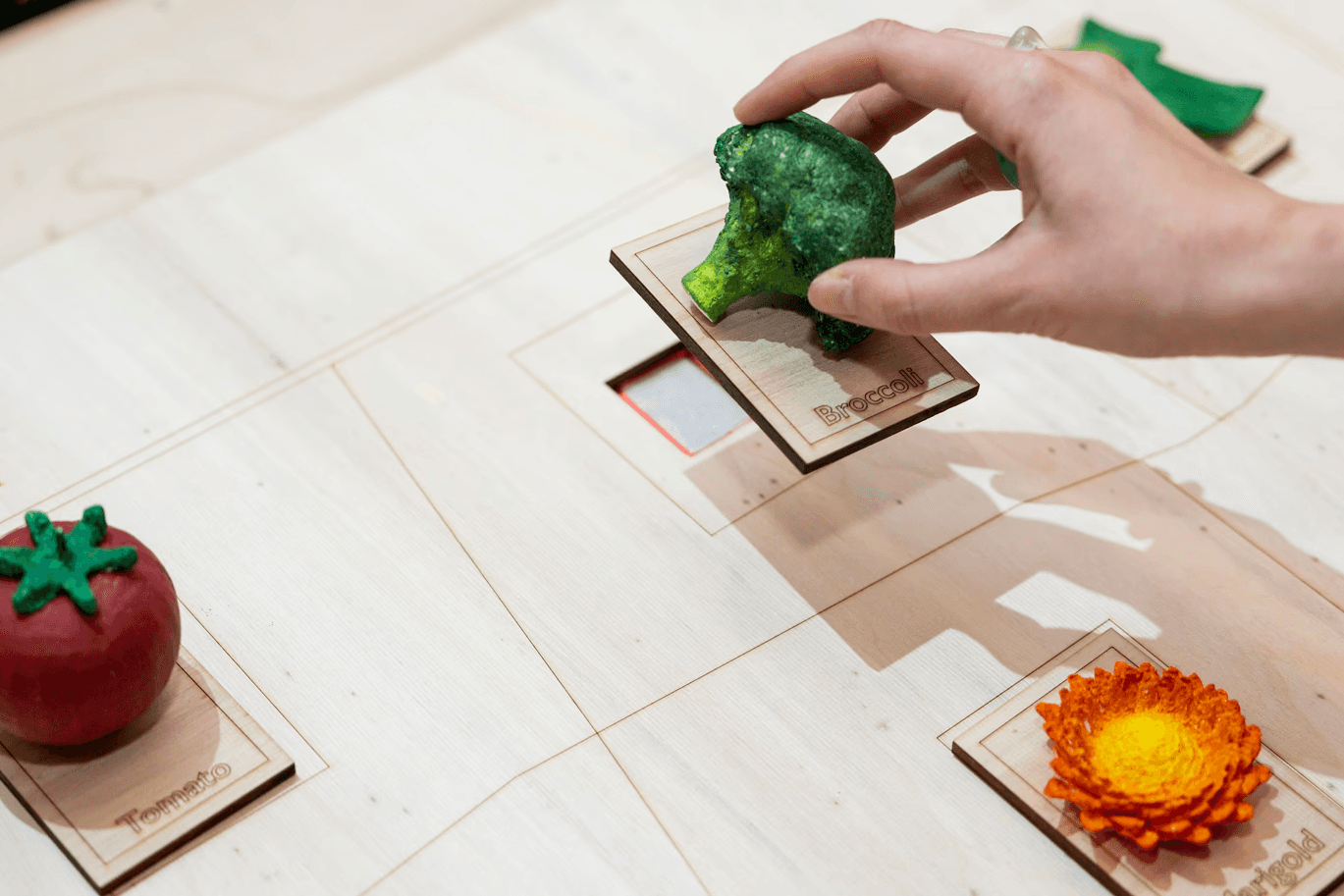
The final design turns plants into characters with voices and personalities. Tomato’s neighborhood was destroyed by monocropping, and visitors rebuild it by placing physical plants on a farm board. When they place a plant, it starts talking. Basil tells Tomato how it keeps pests away, Tomato explains the shade it provides. Through listening to these conversations, people understand regenerative agriculture through empathy instead of facts or lectures.
Most people can’t tell the difference between a conventionally farmed tomato and one grown regeneratively. They taste the same, there’s a price gap, and regenerative agriculture feels like just another buzzword competing with dozens of other food labels. Unilever wanted to cut through that noise, to make people actually understand what regenerative agriculture means through something families could experience in a supermarket.
The final design turns plants into characters with voices and personalities. Tomato’s neighborhood was destroyed by monocropping, and visitors rebuild it by placing physical plants on a farm board. When they place a plant, it starts talking. Basil tells Tomato how it keeps pests away, Tomato explains the shade it provides. Through listening to these conversations, people understand regenerative agriculture through empathy instead of facts or lectures.
Most people can’t tell the difference between a conventionally farmed tomato and one grown regeneratively. They taste the same, there’s a price gap, and regenerative agriculture feels like just another buzzword competing with dozens of other food labels. Unilever wanted to cut through that noise, to make people actually understand what regenerative agriculture means through something families could experience in a supermarket.
The final design turns plants into characters with voices and personalities. Tomato’s neighborhood was destroyed by monocropping, and visitors rebuild it by placing physical plants on a farm board. When they place a plant, it starts talking. Basil tells Tomato how it keeps pests away, Tomato explains the shade it provides. Through listening to these conversations, people understand regenerative agriculture through empathy instead of facts or lectures.
Most people can’t tell the difference between a conventionally farmed tomato and one grown regeneratively. They taste the same, there’s a price gap, and regenerative agriculture feels like just another buzzword competing with dozens of other food labels. Unilever wanted to cut through that noise, to make people actually understand what regenerative agriculture means through something families could experience in a supermarket.
The final design turns plants into characters with voices and personalities. Tomato’s neighborhood was destroyed by monocropping, and visitors rebuild it by placing physical plants on a farm board. When they place a plant, it starts talking. Basil tells Tomato how it keeps pests away, Tomato explains the shade it provides. Through listening to these conversations, people understand regenerative agriculture through empathy instead of facts or lectures.
Exploration
For this project we followed a doing-first approach. We ran one-week sprint cycles where we started the week by defining a concept, during the week we developed and prototyped it (each week with a different technology), and on Friday we tested it, so the following week we could iterate from those results. The goal: make regenerative agriculture understandable.
Early concepts
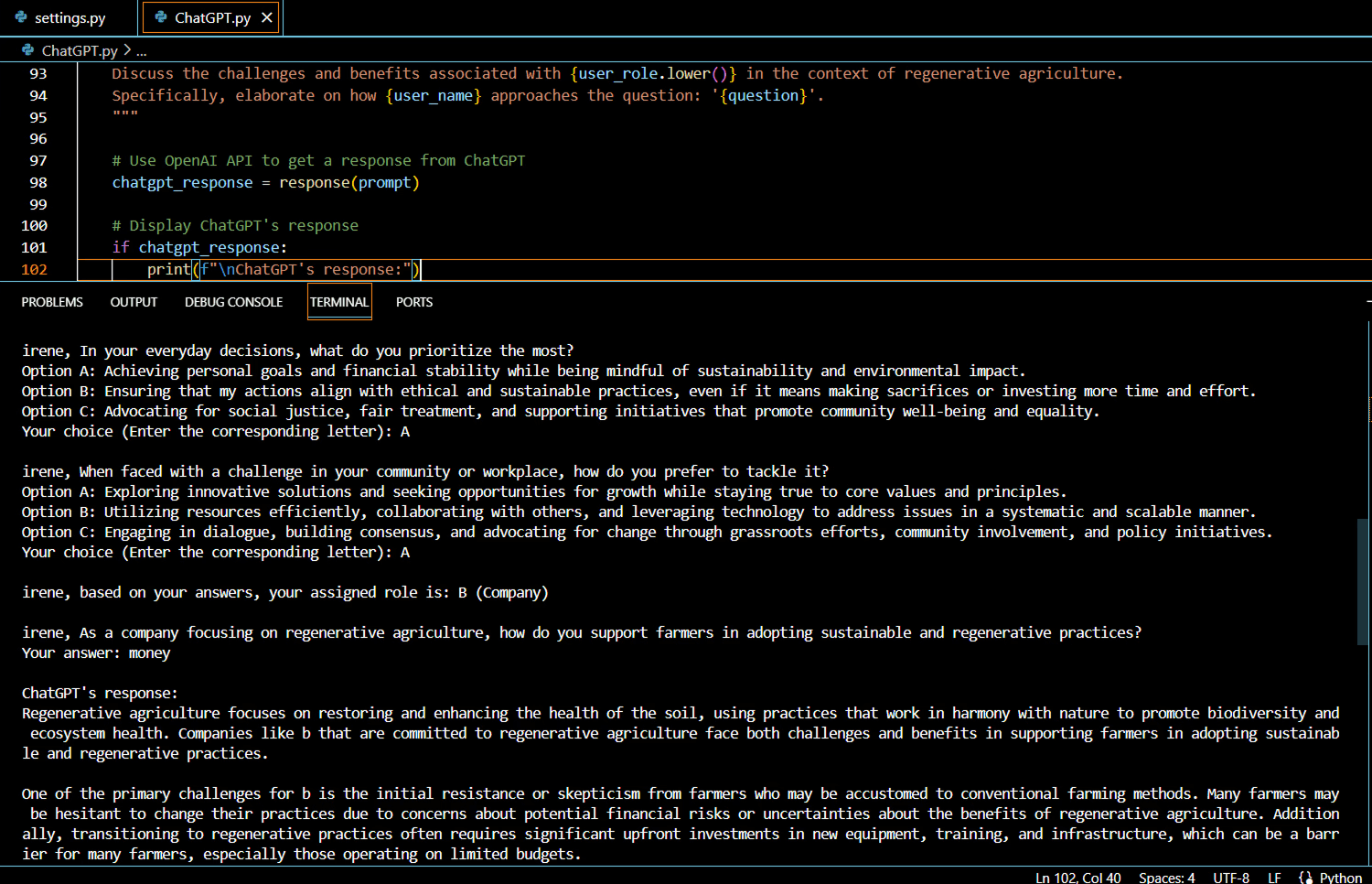
We explored different angles to show the difference between regenerative and conventional products. First, a soup scanner built with Teachable Machine and p5.js let people scan Unox cans to see production stories. Then a ChatGPT chatbot with JavaScript assigned users roles like politician or farmer to reveal how different stakeholders view the food system. Week four brought it back to the farm itself, a physical cardboard prototype with ItsyBitsy kits, LED lights for soil and water levels, touch sensors to balance the ecosystem. User testing showed a consistent problem: people felt accused. The technology worked but the tone was wrong.


Role-based ChatGPT chatbot showing how politicians, farmers, and consumers view the food system differently.
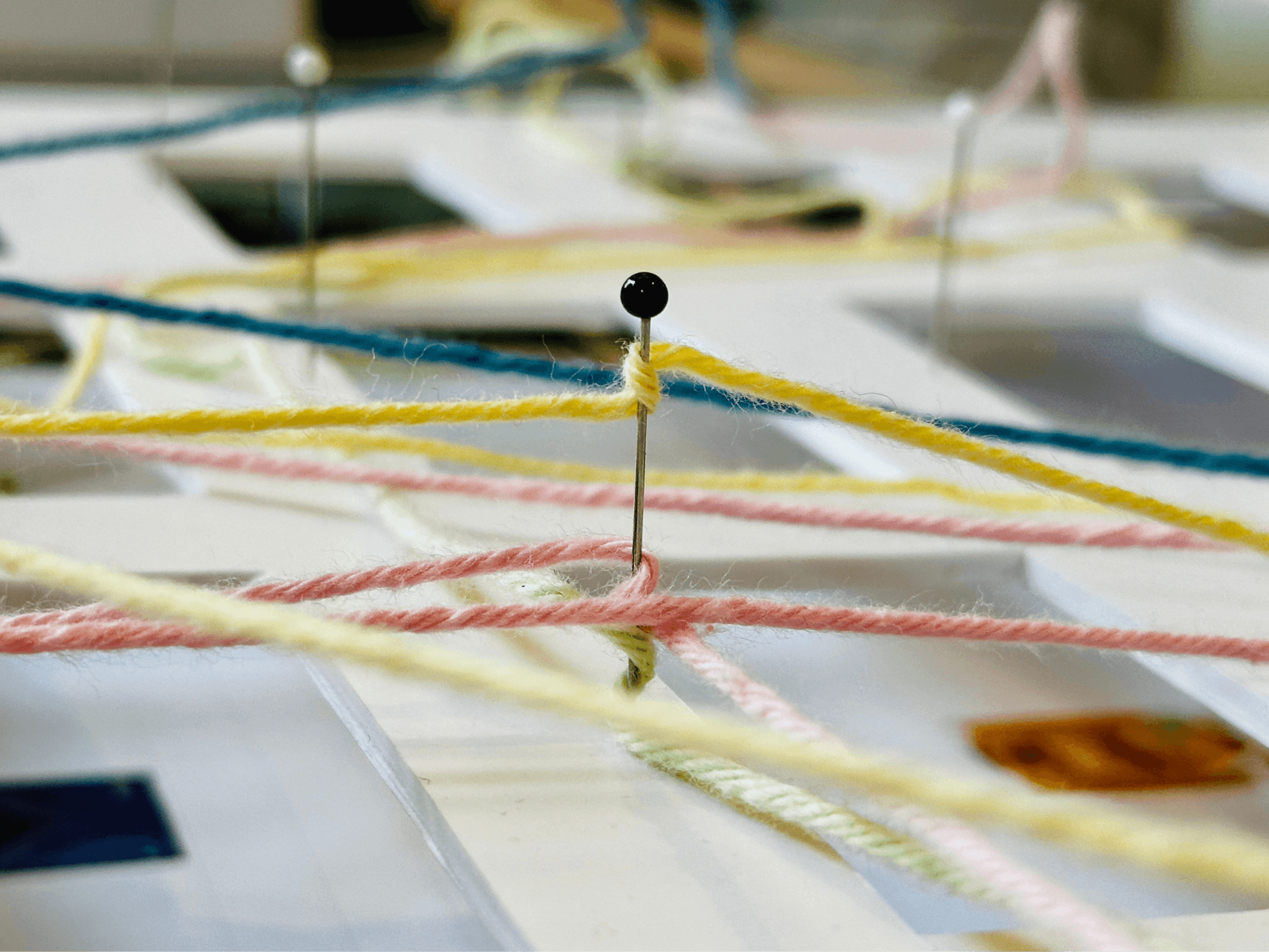


Interactive cardboard farm with ItsyBitsy microcontrollers, visualizing soil, water, and ecosystem balance.
Shifting to kindness
People can look up facts themselves, they just don't, so we tested what would actually make them care. Week five used a Telegram bot feeding p5.js visualizations to show collective impact. Week six built a hologram pyramid displaying plant time-lapses, pursuing engagement through beauty. People loved the effect but couldn't explain what they learned. Testing revealed we needed something visually engaging that informed without being obvious or academic
The Result
The final design took insights from weeks of testing and built an interactive experience where families could learn through play.
The Story
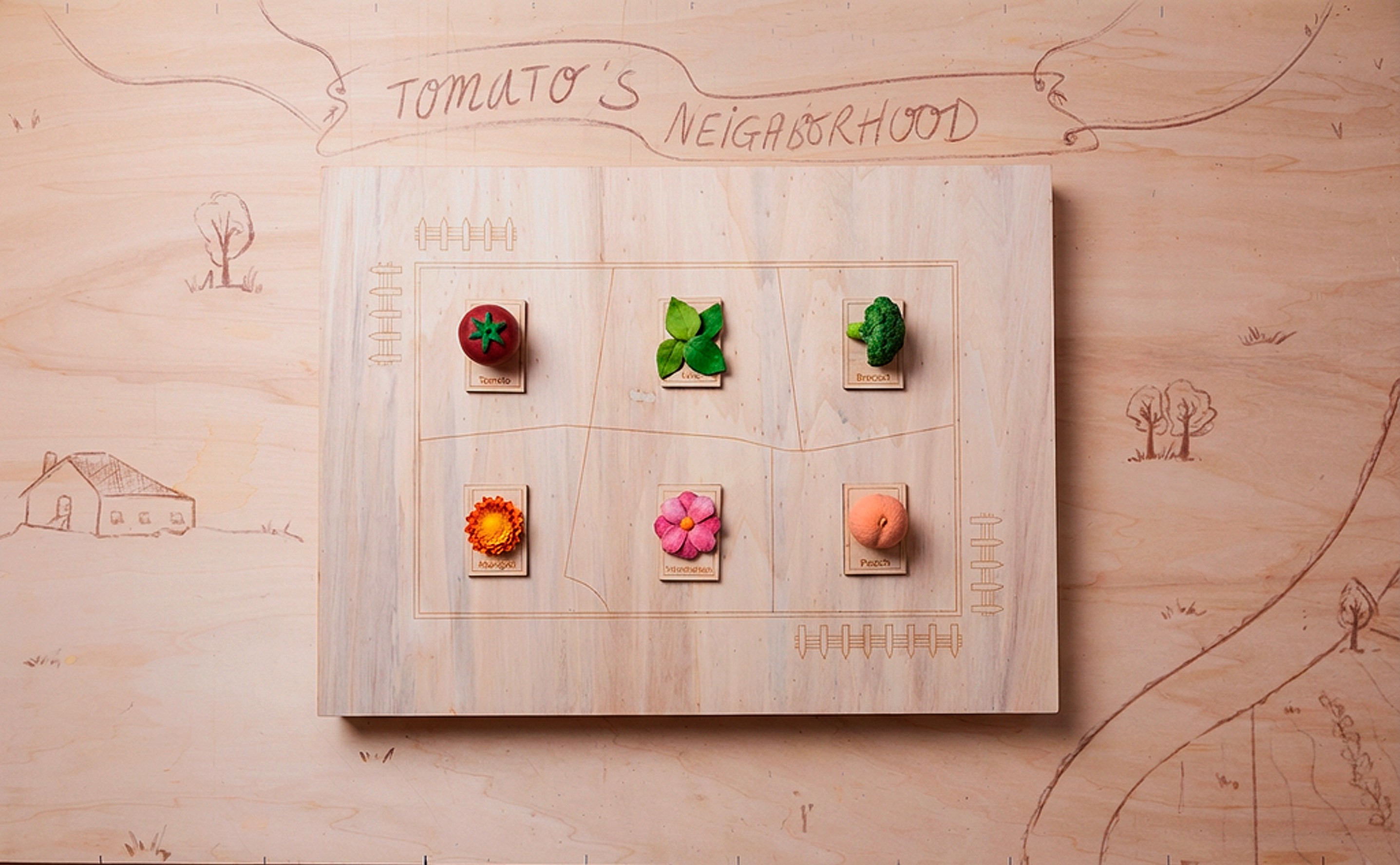
Monocropping destroyed the farm's ecosystem. What used to be a diverse neighborhood where plants supported each other became rows of only tomatoes. The soil degraded, flavors weakened, the system broke down. The challenge: help tomato by placing the right plants around it so they can support each other again.


Flexible enough to install,
strong enough to secure.
Physical Setup & Interaction
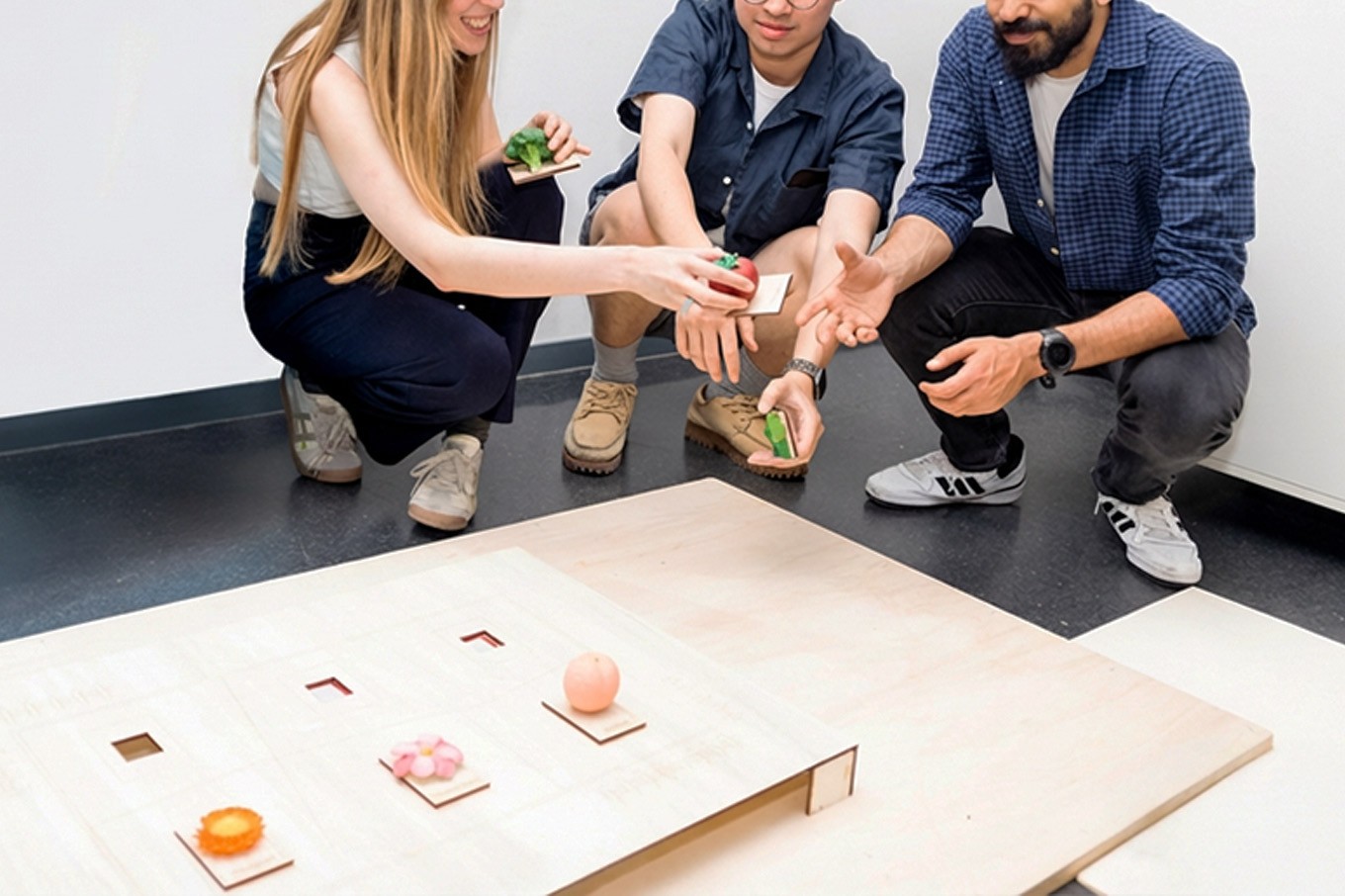
The experience happens on a wooden board representing a farm divided into zones. Players place plant tokens in different sections. Each token has an RFID tag that communicates with ItsyBitsy microcontrollers when placed on the board. The signal travels through an MQTT server to the main controller loaded with audio files, which decides which conversation to trigger. Place basil next to tomato and Basil explains how its aroma keeps pests away while Tomato describes the shade it provides so Basil doesn't dry out. Animations project onto the wooden floor, changing as plants move closer together. The neighborhood rebuilds visually while visitors learn which plants help each other survive.


AI's Role
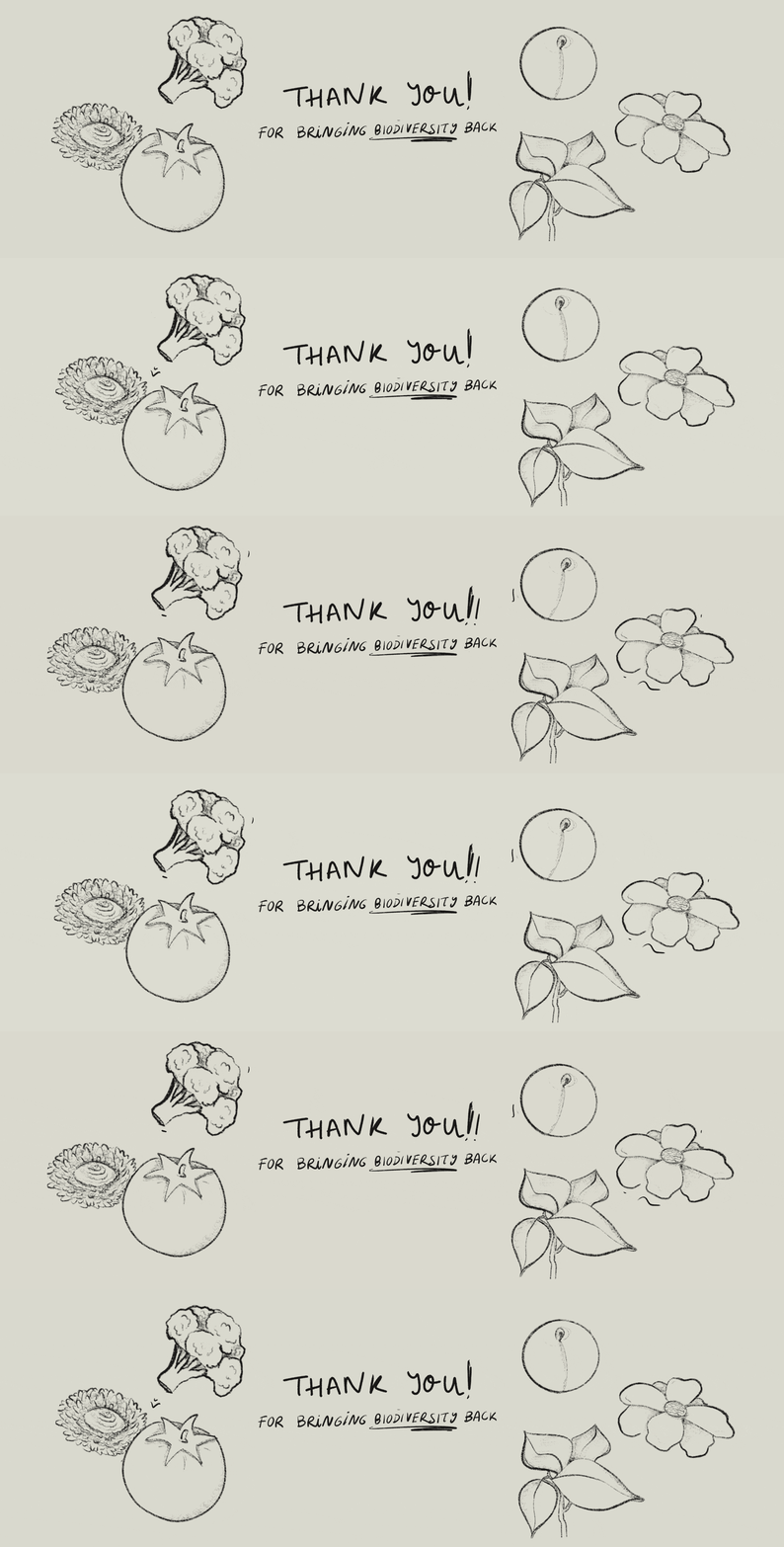
Text-to-speech AI gave each plant a distinct personality and voice tone. Early dialogue drafts were too technical, assumed people already understood companion planting and biodiversity. AI helped simplify the conversations while keeping them accurate. The plants became characters, each with different personalities. Unilever saw potential to develop these characters further for marketing materials.


Learnings
The installation worked. People laughed at the plant voices, showed surprise when animations changed, and understood biodiversity by the end without feeling lectured. Unilever saw potential to develop the plant characters into marketing campaigns. Peers responded to the engaging voice tones and physical takeaway.
The core insight held: empathy drives learning more effectively than information. By hearing plants explain their relationships, families grasped companion planting naturally. The system could scale to educational contexts or online platforms, potentially adding more plants where combinations create different outcomes. Small interactions through character voices create understanding without complex technology or lengthy explanations.
The installation worked. People laughed at the plant voices, showed surprise when animations changed, and understood biodiversity by the end without feeling lectured. Unilever saw potential to develop the plant characters into marketing campaigns. Peers responded to the engaging voice tones and physical takeaway.
The core insight held: empathy drives learning more effectively than information. By hearing plants explain their relationships, families grasped companion planting naturally. The system could scale to educational contexts or online platforms, potentially adding more plants where combinations create different outcomes. Small interactions through character voices create understanding without complex technology or lengthy explanations.
The installation worked. People laughed at the plant voices, showed surprise when animations changed, and understood biodiversity by the end without feeling lectured. Unilever saw potential to develop the plant characters into marketing campaigns. Peers responded to the engaging voice tones and physical takeaway.
The core insight held: empathy drives learning more effectively than information. By hearing plants explain their relationships, families grasped companion planting naturally. The system could scale to educational contexts or online platforms, potentially adding more plants where combinations create different outcomes. Small interactions through character voices create understanding without complex technology or lengthy explanations.
The installation worked. People laughed at the plant voices, showed surprise when animations changed, and understood biodiversity by the end without feeling lectured. Unilever saw potential to develop the plant characters into marketing campaigns. Peers responded to the engaging voice tones and physical takeaway.
The core insight held: empathy drives learning more effectively than information. By hearing plants explain their relationships, families grasped companion planting naturally. The system could scale to educational contexts or online platforms, potentially adding more plants where combinations create different outcomes. Small interactions through character voices create understanding without complex technology or lengthy explanations.